

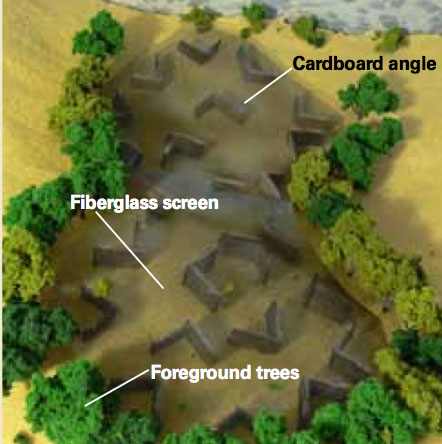
The scenery around Caliente on my layout required several dense forest areas. Using individual tree models for this purpose can be quite expensive, so I turned to puffball trees.
Puffballs are made from pieces of poly fiber that have been soaked with matte medium and covered in various shades and textures of ground foam. I used a mix of Woodland Scenics light and dark green foliage for my puffball trees. [For more information on making puffball trees, see part 4 of the “Build the Virginian” series in the April 2012 Model Railroader.]
I don’t think the puffballs look very realistic simply stuck to the scenery base. They need to be elevated to match the height of the foreground trees around them. For my puffball trees, I start by cutting fiberglass screen to match the area where I wanted my forest. Using my hot glue gun, I glued strips of cardboard into right angles. After attaching the cardboard angles to the screen with more hot glue, I spray-painted the entire assembly black.
I hot-glued the screen on the layout and installed individual foreground trees around its perimeter. Then I filled in the perimeter with puffballs that I adhered to the cardboard with hot glue. The cardboard and screen are completely hidden. As you can see in the above photo, the finished result looks quite realistic.