





The Puget Sound region’s rail-transit agency and fans of a local hamburger chain may find out.
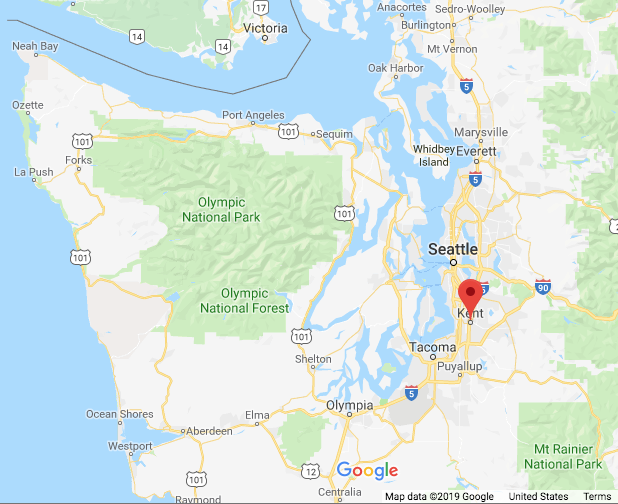
Sound Transit, the regional authority building and operating a light-rail system in Seattle and its suburbs, recently issued a list of six sites it’s studying for an operations and maintenance facility at the south end of its existing Link light rail network.
What caught the eye, and sparked an uproar, with the public and public officials was one of those sites and its current tenant: a burger joint known as Dick’s Drive In.
To area residents, Dick’s is as much a part of local lore as Seattle’s Space Needle, and is older than that landmark too. The small chain, with just seven locations, was famed as a late-night purveyor of inexpensive burgers. The founding family has been lauded for its treatment of employees and its involvement in civic affairs. Even in an era of national chains with far bigger ad budgets, Dick’s retains its popularity. Microsoft co-founder and billionaire philanthropist Bill Gates was recently photographed dutifully standing in line to place an order.
The seventh location opened in Kent in December to much fanfare and after a public vote on where the next location should be.
That the restaurant might be forced to shut so soon after opening does not sit well with ether the company or the city of Kent.
“We welcome the opening of the new light rail station in Kent, just blocks from our new location,” the company said in a letter to Sound Transit. “It will be good for our customers and good for our employees. But, we can’t serve our employees, customers, and communities if we are not there.”
The city went a step further, with council approving an emergency measure imposing a moratorium on development of transit-related facilities on the property in question.
Public officials and the company say that Sound Transit should look instead at a nearby property, a now-closed landfill. Sound Transit says developing that site could entail expensive environmental remediation measures.
Such has been the outcry that Sound Transit felt compelled to post an explanation on its public blog.
“Identifying a site for an OMF is always challenging because it requires at least 30 relatively flat acres that are near the light rail line, with specific site conditions often pushing the acreage requirement higher,” the agency said.
Nothing is going to happen quickly, it added. Preliminary review will be completed this coming May; then Sound Transit’s board will decide which alternatives should be considered further for an environmental impact statement. The environmental statement, it says, “will take up to a couple of years to complete.”


Why is it that corporations demand Green property when there is an abundance of land that has been abandoned for long periods of time that should be redeveloped first? So what if the land fill in question needs to be cleaned up?
This is where Federal, State, County, and State officials should work together with Sound Transit and contribute financial assistance to this cause. Also, Sound Transit, why not add a shiny new penny to each ticket sold, putting this revenue towards the envirnmental clean up as well?
Mr. Landey is right. Nothing gets done anymore because of a total lack of intelligent cooperation between governmental(illness) bodies and public enterprise. This incident is a perfect example and is disgusting in it’s own right!
Darn it people, get off your lazy behinds once and for all, sit down at this Dick’s Drive In location, over burgers and fries and talk til the cows come home if you must, but work together so the land fill in question can be cleaned up for the new maintenence facility.
Do it for the betterment of the environment, tax payers, everyone who loves old fashioned burgers, and last but not least……FOR GOD’S SAKE, DO IT FOR YOUR CHILDREN!
73
As long as its not the original building, so what? Have the transit company pay for the move, or whatever. However if the owners don’t want to move, FIGHT!!!
Correction to my post Dick’s is 65 years old as originally opened on 28 January 1954 on NE 45 Street in Seattle’s Wallingford District.
Why wasn’t this thought about before Dick’s opened? The South Sound area has been wanting a Dick’s for years. The 66 year old burger joint is iconic to Seattle.
Yeah we want the light rail but don’t let it make our burger joint move a block away.
It’s a wonder anything ever gets done in this country.
Actually nothing ever does get done.
I used to live in Seattle. Dick’s is only “legendary” in the locals minds. There is nothing culinary, cultural or more relevant in Dick’s than any Whataburger.
Just Seattle area provincialism showing its face and man they have a lot.
This is just a temporary end-of-track until the line is extended in steps to Tacoma. Why build a facility which may be obsolete on a short time?
Sorry, non-Seattlites (Kentians) that’s not how this area works. You who don’t live here have no understanding. There is no place to move close to the college which supports the location…oh, did the article mention the college? It didn’t? Well, now you know.