

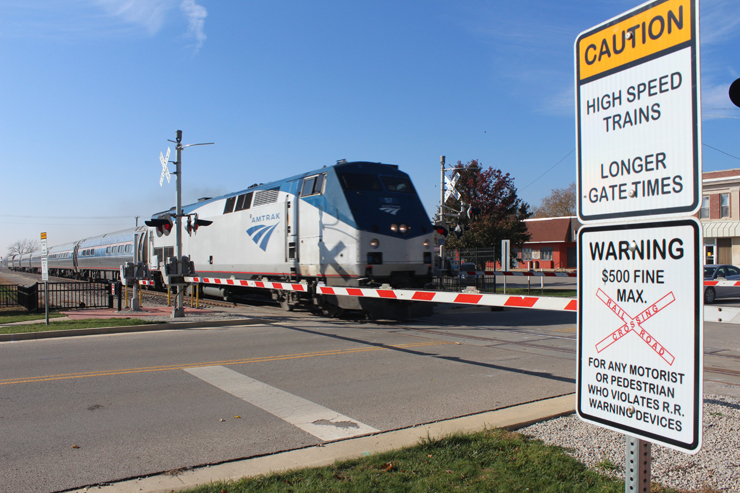
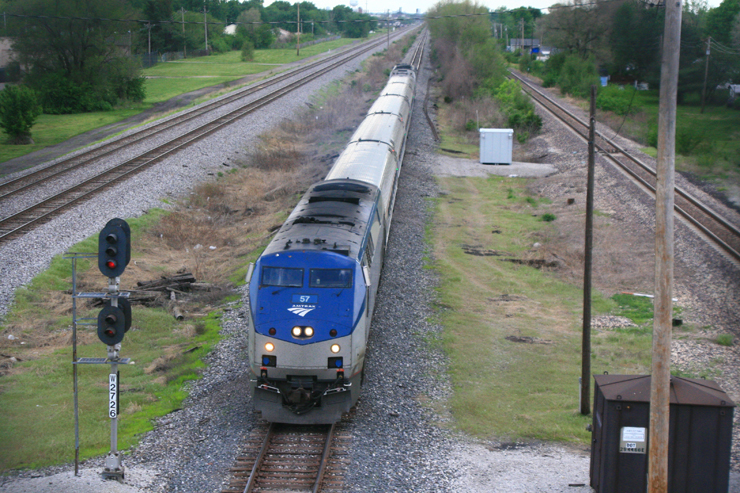
ST. LOUIS, Mo. — Ongoing efforts to increase speeds on Amtrak’s Chicago-St. Louis route have been delayed again, the St. Louis Post-Dispatch reports.
As an intermediate step in plans to eventually offer 110-mph running, the Lincoln Service trains between Chicago and St. Louis were to begin 90-mph operation on parts of the route this summer. But Illinois Department of Transportation spokesman Guy Tridgell told the newspaper that hopes are now to have 90-mph operation between Granite City and Alton, Ill., a segment of approximately 20 miles, by the end of the year. Additional 90-mph should begin next year.
Ongoing work on positive train control technology has slowed the effort to increase speed on the route [see “Faster Midwest service stalled by PTC work,” Passenger, July 2018 Trains.]
Amtrak spokesman Marc Magliari cautioned there was no assurance any 90-mph operation will begin this year. “Well have to test it,” Magliari said, “and the [Federal Railroad Administration] looks at our test data.”
Full 90-mph operation where permissible on the route could shave 15 to 20 minutes off the current schedule, which varies from 5 hours, 20 minutes to 5 hours, 35 minutes. The planned 110-mph operation could save up to 50 minutes.
Meanwhile, northbound trains remain slowed by a segment of 30-mph running near Granite City that has not yet been signalled for 79-mph operation. Those trains lose about 15 minutes on that segment, as much as they would gain in an increase from 79- to 90-mph operation elsewhere.