

Potential long-term changes wrought by the COVID-19 pandemic could present growth opportunities for railroads once the health crisis passes, the chief executives of CSX Transportation and Union Pacific said this week.
The economic fallout from the pandemic may accelerate manufacturing and retail trends that were already under way, CSX CEO Jim Foote and UP CEO Lance Fritz told investors and analysts on the railroads’ earnings calls.
Before the pandemic, manufacturers were beginning to shift production from China to lower-cost countries, including Mexico and those in Southeast Asia. Now that COVID-19 has underscored the importance of having supply chains that are not overly dependent on any one country, manufacturers may move some operations back to the U.S. or to Mexico.
“For sure there are going to be some opportunities to grow out of this crisis,” Fritz says. “One is, we do hear our customers talk about evaluating their supply chains with an eye towards reliability being valued a little bit higher. That means near-shoring or on-shoring some of those supply chains. And that would be a good thing for us generally speaking.”
Fritz said it is way too early to tell the extent to which that might happen, and companies won’t make long-term investment decisions until there are improvements in business confidence and demand.
“But clearly I think we’re going to see that,” Fritz says. “And that will benefit Mexico, it will benefit our to-and-from Mexico business, and it will probably benefit our inside the United States business.”
Foote agrees: “I think that there will be more manufacturing that takes place in this country and any kind of business activity like that, it’s good for the railroad.”
The second opportunity is for intermodal to play a bigger role in e-commerce. Online retail sales were growing rapidly before the pandemic, but have skyrocketed as stores have temporarily closed due to social distancing and other restrictions. Many analysts believe customers will continue to do more of their shopping online once pandemic-related restrictions are lifted.
Foote says intermodal service improvements will help CSX and other railroads land more ecommerce business. What also helps, he says, is that online retailers are now receiving larger quantities of inbound inventory, which better fits into intermodal networks.
“As we go forward, that will be an opportunity for us,” Foote says.
Fritz agrees, but notes that railroads will never be part of one-day delivery. “But we don’t have to be,” Fritz says. “What we have to be is part of the supply chain that gets product to the forward distribution sites that can fulfill like that. And we are.”
Analysts say post-pandemic changes to manufacturing and trade trends will unfold slowly.
“It will take time for those structural shifts to occur. They ultimately are probably somewhat likely to occur, but they won’t happen overnight,” says Todd Tranausky, a rail and intermodal analyst with FTR Transportation, a freight forecasting firm.
“The more immediate volume opportunity would come from additional merchandise traffic they are able to attract by keeping velocity high as trucking capacity tightens up over the course of 2021,” Tranausky says.
Intermodal analyst Larry Gross says companies will reconsider the wisdom of relying so much on China as well as just-in-time inventory systems that are vulnerable to disruptions. The result, he says, will be more manufacturing near and in the U.S.
This would mean international intermodal growth will slow and the shift of traffic from West Coast ports to East Coast ports will continue, Gross says.
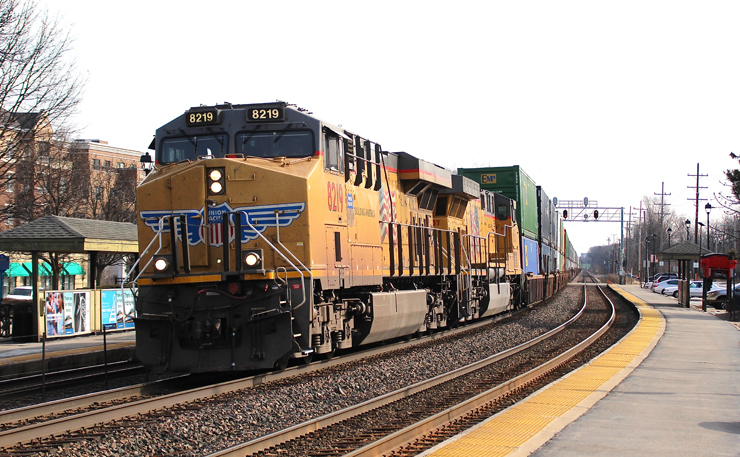
Containers that land at East Coast ports and are bound for inland points are far more likely to be truck moves, while West Coast port boxes tend to move inland in stack trains.
Domestic intermodal may face challenges as freight moves to more widely dispersed distribution centers that are closer to consumers.
“The bottom line is that amalgamating volumes into megatrains will become more difficult,” Gross says. “Freight will become more dispersed …. Intermodal can certainly compete in this changing environment. But it will require more agility and some altered thinking. Continuing to focus on running the simplest network of the largest trains possible is not going to be a recipe for success in the post-pandemic world.”