





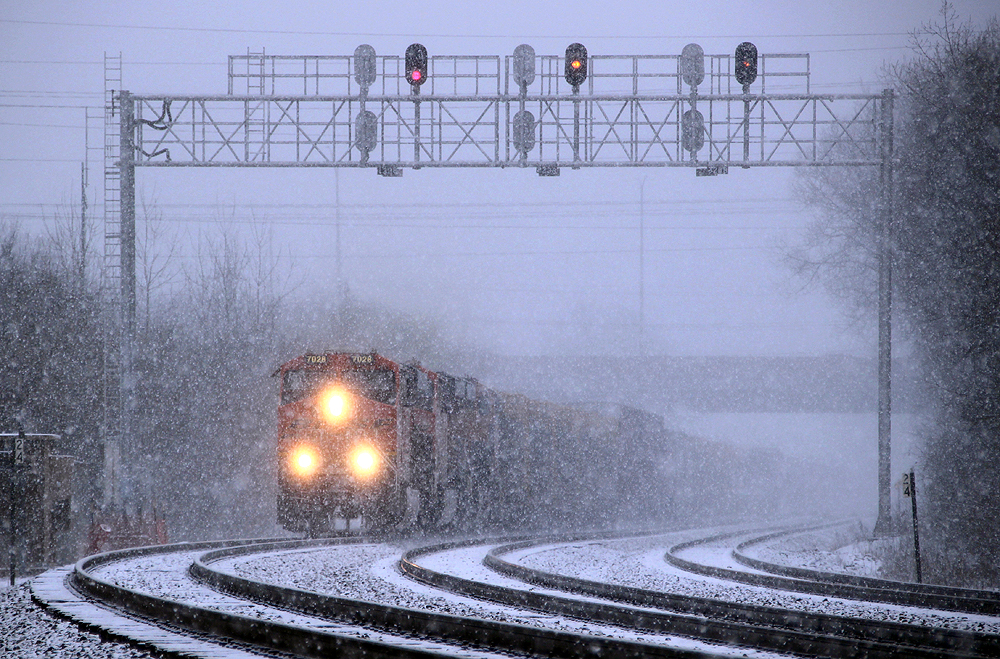
FRONT ROYAL, Va. — Members of the Brotherhood of Railroad Signalmen have voted against ratification of the tentative agreement union leaders had reached with the U.S. Class I railroads on Sept. 15.
Nearly 61% of the rank and file voted no, while 39% voted yes for the proposed contract. The two sides now will head back to the bargaining table.
Six of the 12 unions representing railroad workers have ratified their contracts. The BRS becomes the second to reject the tentative agreement. The Brotherhood of Maintenance of Way Employees rejected their contract on Oct. 10.
“For the first time that I can remember, the BRS members voted not to ratify a National Agreement, and with the highest participation rate in BRS history,” union President Michael Baldwin said in a statement. Nearly three quarters of the union’s 6,339 members returned their ballots.
Baldwin expressed disappointment with what he called “the lack of good-faith bargaining” on the part of the National Carriers’ Conference Committee, which represents the railroads. He also said the Presidential Emergency Board recommendations, which did not address working conditions such as paid sick leave, played a role in the members’ decision.
The railroads and emergency board also failed to recognize the important work signalmen perform, he added.
“Without signalmen, the roadways and railroad crossings would be unsafe for the traveling public, and they shoulder that heavy burden each day,” Baldwin said. “Additionally, the highest offices at each carrier, as well as their stockholders, seem to forget that the rank-and-file of their employees continued to perform their job each day through an unprecedented pandemic, while the executives worked from home to keep their families safe.”
The proposed contract included a 24% compounded raise over the five-year life of the deal, plus five $1,000 bonuses.
“We are disappointed that the Brotherhood of Railroad Signalmen has failed to ratify the recent tentative agreement with the nation’s freight railroads, delaying the benefits of the tentative agreement for BRS-represented employees and further extending resolution of the bargaining round with BRS,” the National Railway Labor Conference said in a statement.
The railroads’ negotiating arm adds: “In its announcement regarding the ratification results, BRS asserts that the tentative agreement is inadequate because it does not provide for additional paid sick time. However, the vast majority of BRS members work predictable schedules and all have access to time off. Like other rail employees, they can and do take time off for sickness and already have paid sickness benefits beginning after four days of illness-related absence and extending for up to a year. The structure of these benefits is a function of decades of bargaining where the unions have repeatedly agreed that short-term absences would be unpaid in favor of higher compensation for days worked and more generous sickness benefits for longer absences.”
The rejection results in a status quo period where the BRS will begin new talks with the railroads.
That status quo period will extend to five days after Congress reconvenes, which is currently set for Nov. 14. If Congress returns to session on November 14, there would be no “self help” until after Nov. 19.
But the National Railway Labor Conference said the two sides had agreed to a status quo period until early December. “As such, the failed ratification does not present risk of an immediate service disruption,” the NRLC said.


Nobody should have to work without guaranteed days or day off per week (or month). And I do mean GUARANTEED. Regardless of how many have “marked up”
Railroads have nothing close to that. Right now attendance policies are treating T&E employees like crap. That should end and that is probably what this fight is all about. If not, it should be.
All this seems like foolish management pig headedness. Running a railroad these days is hugely profitable (see other news wire articles). A strike will greatly damage that process. Will reasonable sick time cause such a big hit to management’s bonuses and stock funds’ profit? Enough to make a fight worth it? I doubt it. Pay is not the issue. Control of lives is; is that really a good basis for management to be so intractable?
When I hired out in the 70’s it was possible to mark off sick, even when being called to work, without any repercussions. Worker abuse of this and the thinning of the worker’s ranks led to this being restricted severely, as it is today.
That situtation applies to almost every single business out there…perhaps with the exception of the tech industry. Every busines has cut back staffing to the barest minimum needed to operate, there are no cushions if people call out. No one overstaffs, even though overstaffing would allow for sick calls, training and vacations…Wall Street deems overstaffin as non-viable.
I do not work for the railroads nor have I ever worked for the railroads…I did work at a 3rd party intermodal provider for 17 years and both of my parents worked for the SP way back when. What you employees are asking for needs to be changed by Congress, because everything is based on the Railway Labor Act/RRB, which covers railroad workers and certain other transportation workers. You are not covered by other Federal labor laws or state labor laws for that matter, just like government employees are only covered by the Federal labor laws and not whatever laws the particular state they might work in has. So even though I work in California, not a single California labor law applies to me as a Federal employee. Just like you as a railroad employee, you are covered by whatever the Railway Labor Act says and no other Federal labor laws. That is how it works, if you want to change it, talk to Congress about it.
At this point, I would not be surprised if both BLET and SMART-TD rejected their tentative agreements.
It’s not a response to what happened during the supposed corona virus crap( which mr. McFarlan I think that’s the only thing I’ll ever agree with you on in that it was an overreaction) it’s a response to decades of never having sick leave in our contracts, and before you have some sly rebuttal the carriers have for many more then a few decades been fighting the unions on this very subject, it’s finally come to a head and they are as such fighting us on it in this round. They want nothing less than their employees working for them 24/7 non stop and I mean non stop no time away whatsoever. Fortunately for us the government has laws against us being stuck at work in perpetuity much to the railroads dismay. There have never been agreements in place to guarantee time away but there have been agreements that allowed us to have up to 15 days off as long as you marked up at that 23 hour of that 15th day,but they’ve circumvented them by coming up with availability policies that in turn have been fought by the unions in the courts and have been shot down by judges that everyone who knows were paid off by the railroads. So you really haven’t a clue what you’re talking about ,we have never agreed to anything when it’s came to leave and have always been at the wrong end of the gun when we have tried in the past.
I can only speak to what benefits T&E get and not what the signalman might have that would be different in their agreement. As far as T&E there are no paid sick days or benefits outside of what is available through the Railroad Retirement Board. And what is offered through RRB is but a drop in the bucket as compared to a normal days wage.
Railroad management continues to claim employees can take time off. Sure you can. What they don’t talk about is the quotas that are in place that severely limit the number of people that can take time off at any one time. Spouse in ICU and you need time off to care for them??? Whoops. Quota is filled you can’t take off. So you do anyways and will be punished.
Gerald you have proven yourself to be totally ignorant of what railroad employment at a Class 1 is like. Or you are a high level manager sitting in your ivory tower posting under a pseudonym.
So now all of the sudden after the pandemic these union employees want to change decades of agreed upon benefits regarding sick leave. What was so different about the pandemic that makes the union members want to upend decades of precedent? They’re acting just like the Supreme Court, and almost everyone has lost confidence in that branch of government already.
Do not talk to me about how different the pandemic was vs regular illness, we’re all aware of that…we’re also all aware(or should be) that this country and many others went overboard in handling it.
Well, Gerald. I couldn’t agree more that we went overboard on COVID response. I talk about that all the time, including today when I was told I’m supposed to be careful b/c someone at church came down with COVID. Heck, in the last three years I’ve been around countless thousands of people, and countless thousands of people have been around me. I’m fine. Everyone in my immediate orbit – friends, family, Burlington and the other pets, are fine.
Now, back to the article. QUESTION: Have all the rail unions voted so far? How about the unions representing T&E, have they voted? Are we waiting for the biggest and baddest shoes to fall?
You just proved what an uninformed anti-union carrier shill you are with the statement,
“these union employees want to change decades of agreed upon benefits regarding sick leave”
…..that’s the main issue slick; there is NO paid sick leave for any agreement employees in any craft. If you’re sick, it counts against you. If you need to go to the doctor, it counts against you. If someone in your family is sick, you guess it, it counts against you.
The unions have been trying to negotiate some type of sick leave or occasional leave that doesn’t land you in their self imposed POLICY (not agreement) for years. The railroads won’t even talk about it.
How is it that the RR claimed everyone needed to get the Covid shot because they were federal contractors. Ok fine. Federal Contractors are mandated to have 15 paid sick leave -the RRs didn’t want to do that. So which is it? Nobody knows; the railroad’s won’t even address it.
Clearly, you think you know everything, but in reality you don’t know if you’re washing or drying.
Stephen, I do not work for the railroads nor have I ever worked for the railroads…I did work at a 3rd party intermodal provider for 17 years and both of my parents worked for the SP way back when. What you employees are asking for needs to be changed by Congress, because everything is based on the Railway Labor Act, which covers railroad workers and certain other transportation workers. You are not covered by other Federal labor laws or state labor laws for that matter, just like government employees are only covered by the Federal labor laws and not whatever laws the particular state they might work in. So even though I work in California, not a single California labor law applies to me as a Federal employee. Just like you as a railroad employee, you are covered by whatever the Railway Labor Act says and no other Federal labor laws. That is how it works, if you want to change it, talk to Congress about it.